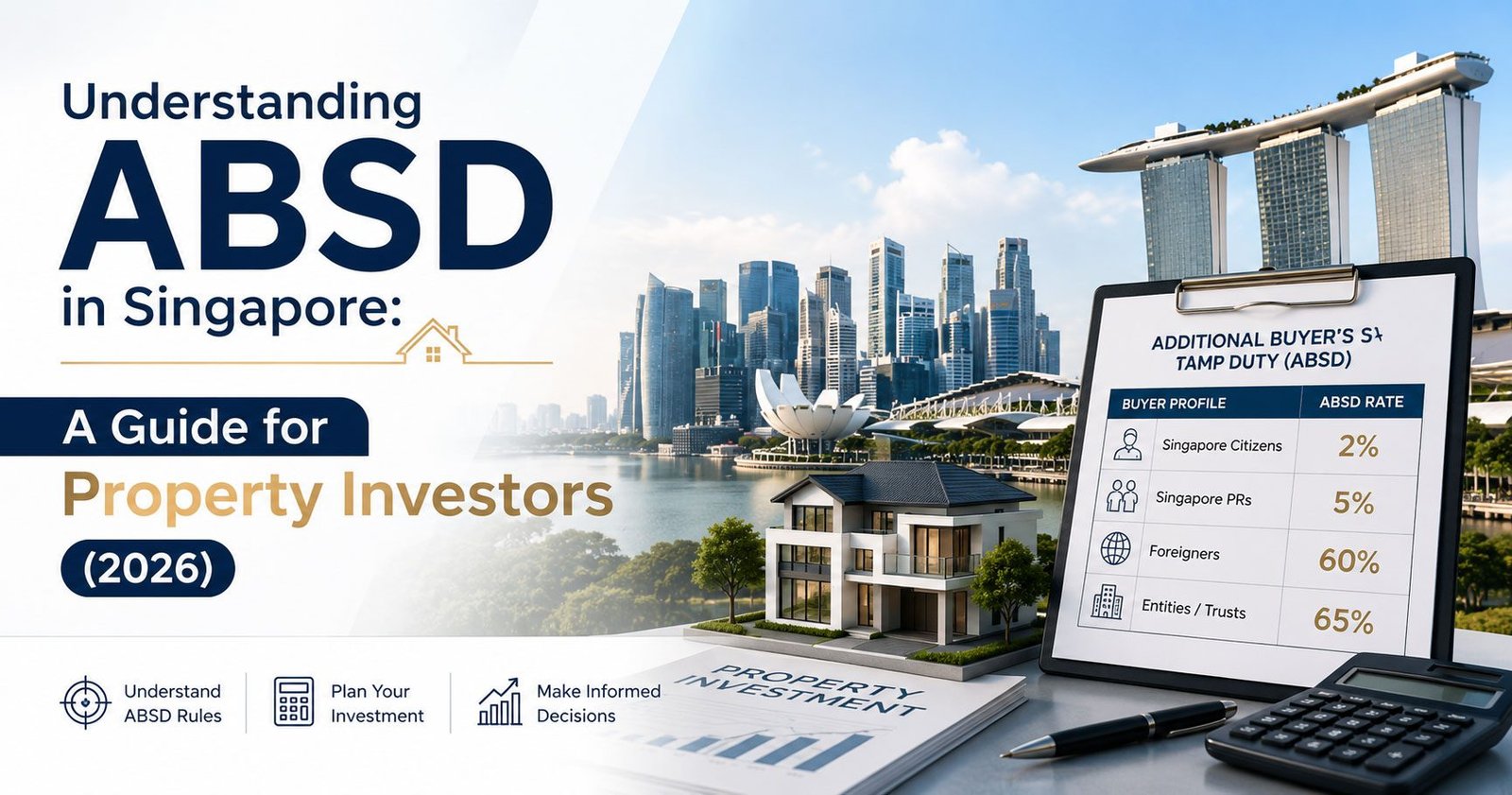
ABSD (Additional Buyer’s Stamp Duty) is a tax the Singapore government charges on residential property purchases, on top of the standard Buyer’s Stamp Duty. The rate depends on your residency status and how many residential properties you already own, from 0% for a Singapore Citizen’s first home to 60% for foreigners and 65% for entities. For investors, it is one of the single largest costs to plan for.
What Is ABSD and Why Does It Matter?
If you’re considering buying a second or third property in Singapore, one term you’ll encounter early and often is ABSD (Additional Buyer’s Stamp Duty). First introduced in 2011 and revised multiple times since, ABSD is a government-imposed tax designed to cool speculative demand and keep Singapore’s property market stable and accessible.
For investors, ABSD is not a dealbreaker but it is a cost that must be factored carefully into every calculation. Understanding how it works, who pays what, and when you can avoid or minimise it is essential to making a smart property investment decision.
ABSD Rates in Singapore (2026)
ABSD is calculated as a percentage of the purchase price or market value of the property, whichever is higher. These rates have applied since 27 April 2023 and remain current in 2026.
For Residential Property Purchases
| Buyer Profile | 1st Property | 2nd Property | 3rd & Subsequent |
|---|---|---|---|
| Singapore Citizen (SC) | 0% | 20% | 30% |
| Singapore Permanent Resident (SPR) | 5% | 30% | 35% |
| Foreigner | 60% | 60% | 60% |
| Entity (company, trust) | 65% | 65% | 65% |
Note: ABSD rates are subject to change. Always verify the latest rates at iras.gov.sg.
What Counts as a Property for ABSD Purposes?
- Any residential property in Singapore, whether HDB, private condo, landed, or EC (after privatisation)
- Properties held globally do not count — only Singapore properties
- Properties held jointly still count as one property each for each owner
How ABSD Is Calculated
Let’s say you’re a Singapore Citizen buying a $1.5 million condominium as your second property:
- ABSD rate: 20%
- ABSD payable: $1,500,000 × 20% = $300,000
That’s $300,000 on top of your Buyer’s Stamp Duty (BSD), down payment, legal fees, and renovation costs. ABSD must be paid in cash within 14 days of signing the Sales & Purchase Agreement (or within 30 days if the document is signed overseas).
This is why ABSD planning is so critical. Ignoring it — or miscalculating it — can completely derail an investment plan.
When Can You Avoid or Reduce ABSD?
1. The HDB Upgrader Remission
If you’re a Singapore Citizen married couple buying a private property and you currently own one HDB flat, you can apply for ABSD remission on your second property — provided you sell your HDB flat within 6 months of the private property’s purchase date (for completed properties) or TOP/CSC date (for uncompleted properties).
This allows upgraders to buy first and sell later without paying the 20% ABSD upfront, but the clock starts ticking from the moment you sign, and the remission is forfeited (with interest) if you miss the deadline. For the full step-by-step sequence, see our HDB upgrader timeline guide.
2. Married Couples “Decoupling” (Private Property Only)
Decoupling is a strategy where a married couple who jointly own a private property restructure ownership so that one spouse transfers their share to the other. The spouse who is bought out ends up owning nothing which resets them to first-time-buyer status, letting them buy the next property at 0% ABSD (as a Singapore Citizen) instead of 20%.
Worked example: A couple jointly owns a $1.5M condo. Spouse A transfers their 50% share to Spouse B. Spouse B now owns 100% of the condo; Spouse A owns nothing and can buy the next property ABSD-free versus roughly $300,000 in ABSD on a second $1.5M purchase.
It is not free, though. Decoupling is legally a property transfer, so it carries real costs:
- Buyer’s Stamp Duty (BSD) on the value of the share being transferred, paid by the spouse acquiring the share.
- CPF refund: the spouse giving up their share must refund the CPF monies they used for the property, plus accrued interest, back into their CPF account.
- Two separate law firms: because the spouses act as buyer and seller, conflict-of-interest rules require separate conveyancing lawyers, roughly double the usual legal fees.
- Loan re-application: the remaining owner usually has to refinance the mortgage solely in their name and re-qualify under TDSR rules.
- Seller’s Stamp Duty (SSD) may apply if the property is still within its minimum holding period.
All-in, decoupling a $1.5M condo typically costs around $40,000–$50,000, still far less than $300,000 in ABSD, which is why it can make sense for the right couple. Note that HDB flats generally cannot be decoupled; HDB removed this option in 2016, so this strategy applies to private property only.
An important warning. Genuine decoupling reflects a real, lasting change in ownership. It is very different from contrived “99-to-1” (or “99-1”) arrangements, where a buyer adds or removes a co-owner shortly after purchase purely to sidestep ABSD. Since 2023, IRAS has actively audited these schemes and clawed back the avoided ABSD with a 50% surcharge on the additional duty. Always decouple for legitimate reasons and with a qualified conveyancing lawyer.
3. Buying Under a Trust for Children
Some investors explore purchasing property under a trust for their children. However, since the 2022 rule changes, trustee purchases of residential property are subject to the highest applicable ABSD rate (65%). A remission may be applied for where all beneficial owners are identifiable individuals, but this strategy is far less attractive than it once was, get specific advice before pursuing it.
4. First-Time Buyer
If you’ve never owned a property before, you pay 0% ABSD as a Singapore Citizen, meaning the first purchase is always the most cost-efficient entry point.
ABSD vs. Expected Returns: Running the Numbers
Let’s run a simple investor scenario:
- Property: $1.5M 2-bedroom condo in Jurong Lake District
- Buyer: Singapore Citizen, second property
- ABSD: $300,000
- Estimated rental income: $3,500/month → $42,000/year
- Gross rental yield (on purchase price): 2.8%
- Gross rental yield (including ABSD in cost base): $42,000 / $1,800,000 = 2.3%
As you can see, ABSD significantly compresses your effective yield. This is why many investors who pay ABSD are playing a capital appreciation game rather than a yield game, they’re betting on the property’s value rising enough to absorb and exceed the ABSD cost over time.
Investment Strategies in an ABSD Environment
Strategy 1: Focus on Your First Property
If you’ve not yet bought any property, your first purchase is your most powerful. Zero ABSD, maximum CPF usage, and full loan eligibility, use it wisely. Not sure what your budget supports? Get a free indicative valuation on your property to start planning.
Strategy 2: Consider Overseas Property
Some Singapore investors are turning to overseas markets (Australia, Japan, UK, Malaysia) where ABSD does not apply. Returns and risks vary significantly, and currency risk must be factored in.
Strategy 3: Commercial Property
Commercial properties are not subject to ABSD. Shophouses, retail units, and office spaces are increasingly popular with Singapore investors who want real estate exposure without the ABSD burden. Note that CPF cannot be used for commercial purchases.
Strategy 4: Long Hold Horizon
For investors who do pay ABSD, a 10+ year hold is often required to meaningfully recover the ABSD cost through appreciation and rental income. Buying in high-growth corridors (Jurong, Woodlands, Paya Lebar) enhances this potential, browse current new launch developments to see what’s available.
Key Takeaways
- ABSD is a real and significant cost, never ignore it in your investment calculations
- Singapore Citizens have the most favourable ABSD rates; PRs and foreigners pay substantially more
- Strategies like the HDB upgrader remission and decoupling can reduce ABSD exposure, but require careful planning
- Consider your hold period, yield expectations, and exit strategy before committing
Frequently Asked Questions
What is ABSD in Singapore?
ABSD (Additional Buyer’s Stamp Duty) is a tax imposed on residential property purchases in Singapore, charged on top of the standard Buyer’s Stamp Duty. It was introduced in 2011 to moderate property demand, and the rate depends on your residency status and the number of residential properties you already own.
How much is ABSD for a second property in Singapore?
For a Singapore Citizen, ABSD on a second residential property is 20% of the purchase price or market value, whichever is higher. Singapore Permanent Residents pay 30% on a second property, and foreigners pay 60%.
Can I avoid paying ABSD?
There are legitimate ways to reduce ABSD, including the HDB upgrader remission (sell your existing flat within 6 months), decoupling between married spouses on a private property, and buying commercial property, which is not subject to ABSD. Each option has trade-offs and costs, so professional advice is essential and contrived “99-1” arrangements to dodge ABSD are illegal and actively penalised by IRAS.
Is ABSD payable in cash?
Yes. ABSD must be paid upfront in cash within 14 days of signing the Sales & Purchase Agreement (30 days if signed overseas). It cannot be funded by your bank loan, and CPF can only be used to reimburse stamp duty in limited cases, so investors should be ready to pay ABSD in cash.
Do foreigners pay ABSD in Singapore?
Yes. Foreigners pay a flat 60% ABSD on any residential property purchase in Singapore, regardless of whether it is their first or a subsequent property. The exception: under Free Trade Agreements, nationals of the United States, Iceland, Liechtenstein, Norway and Switzerland are accorded the same ABSD treatment as Singapore Citizens. Verify your eligibility with IRAS.
Plan Your Property Investment with Confidence
Navigating ABSD, stamp duties, and financing rules in Singapore can feel overwhelming, but you don’t have to figure it out alone. I help investors run the full numbers, understand their options, and make informed decisions aligned with their financial goals.
Let’s talk! Contact Shawn Sum at +65 9239 4968 or visit shawnpropertyhub.com.
Disclaimer: ABSD rates and exemptions are subject to change by the Singapore government. All figures used are illustrative. This post is for educational and informational purposes only and does not constitute financial, legal, or real estate advice. Please consult IRAS.gov.sg and a licensed property agent or conveyancing lawyer for the latest information.